
Custom Development
How to separate scope from timeline in a custom build
Sep
The problem: one request is carrying three different decisions
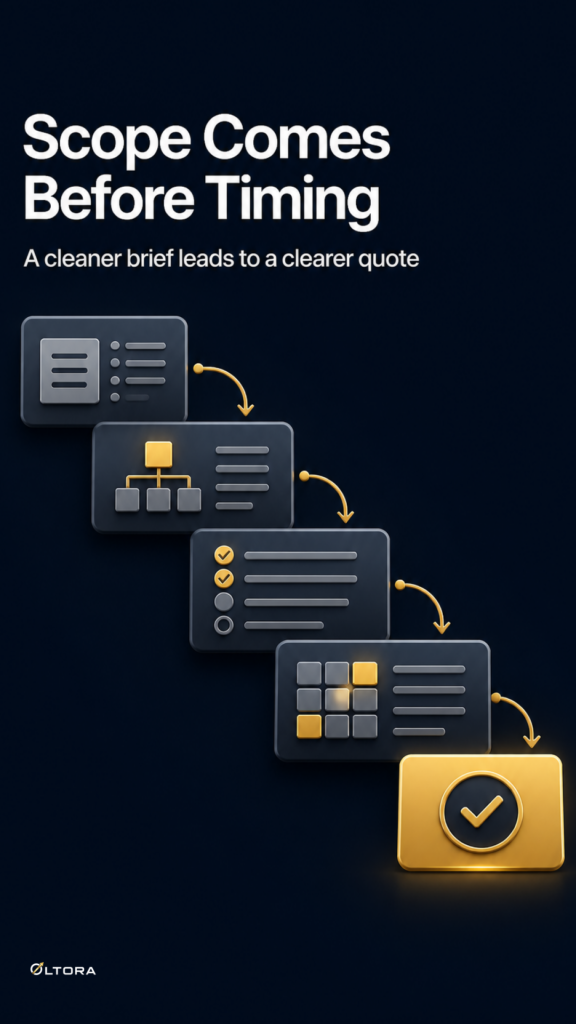
When a custom project is still being discussed, people often ask for one thing: a quote. But a quote only works when three separate parts are already distinguishable. The first is scope, meaning what the build is meant to do. The second is deliverables, meaning what will actually be handed over. The third is timeline expectations, meaning when the work should happen and in what order.
If those parts are mixed together, the conversation gets noisy fast. A feature can sound essential even when it is really a later-stage improvement. A deadline can look fixed even when it depends on an unresolved integration. And a price can appear neat while the real work remains undefined.
That is why a custom development consultation exists: to slow the conversation down enough to separate the moving parts before anyone commits to a build. You can see the service here: Custom Development Consultation.
Think of the project as three layers
A useful way to review a custom website, app, or platform project is to treat it as an architecture problem rather than a wish list.
- Scope answers what the system must do.
- Deliverables answer what gets produced at the end of the consultation or project phase.
- Timeline expectations answer what needs to happen first, what can wait, and what depends on another decision.
These layers are related, but they are not interchangeable. If you change the scope, the deliverables may change. If you change the integration environment, the timeline may shift. If you tighten the deliverables, the project may become easier to quote. The key is to keep each layer visible long enough to make a clean decision.
Start with the part that creates the most uncertainty
Most custom projects do not need every detail before the first serious conversation. They need the first unknown removed. In practice, that usually means identifying which system will sit at the center of the project.
For example, a business might know it needs a client-facing portal, but it may not yet know whether the portal has to connect to an existing website, pull data from another platform, or simply present structured information. Those are different integration environments, and each one changes the shape of the work.
That is the point where scope and timeline start to diverge. A project with a simple standalone interface may be easier to estimate than one that has to preserve data flow with another system. If the integration question is still open, a timeline estimate is usually premature.
What a useful consultation should help you answer
The value of a paid consultation is not that it turns an idea into code. It is that it gives enough attention to answer the questions that affect the quote.
- What business problem does the build have to solve?
- Which features are essential for the first version?
- What existing website, app, or platform has to be reviewed?
- What information must move between systems?
- Which parts are deliverables and which parts are assumptions?
Those questions help preserve the right state before development begins. Once the build starts, changing assumptions becomes expensive in time and attention. A better scoping conversation keeps the project’s structure clear before that happens.
How to sort features from deliverables
This is where many briefs become tangled. A feature is a capability. A deliverable is the thing that is agreed and handed over. The two can overlap, but they should not be written as if they are the same.
Suppose a business wants a booking workflow. The feature is the booking logic. The deliverable might be a page or module that supports it, plus any related admin setup. If the project also needs an existing site reviewed, that review is not the same as the build itself. It is part of the consultation and quoting process, not the development output.
Separating those layers makes it easier to ask a developer for a real estimate instead of a vague reassurance. It also helps the client decide what belongs in phase one and what should wait.
Timeline should follow dependencies, not enthusiasm
Deadlines matter, but they become useful only after the project’s dependencies are visible. A timeline built on enthusiasm is easy to overpromise and hard to keep. A timeline built on dependencies is slower to state and more reliable to use.
For example, if one part of the project depends on how an existing platform behaves, the consultation needs to uncover that before anyone guesses at a start date. If the deliverables are still being defined, the timeline should remain flexible. And if a client is comparing a fixed public price with a custom quote, the quote will only be meaningful when the scope has enough detail to support it.
That is the main difference between public pricing and custom development: one is built for a defined offer, the other is built for a project that still has open variables. The project becomes quoteable when those variables are made visible.
A simple way to prepare for the consultation
You do not need a technical spec to make the conversation useful. A short, structured brief is usually enough.
- Describe the problem in one sentence.
- List the first version features only.
- Note any existing site or platform that must be reviewed.
- Identify outside systems or tools that may need to connect.
- State any timing constraints that depend on other decisions.
That short list does one job well: it gives the consultation a place to start. From there, scope can be narrowed, deliverables can be named correctly, and timeline expectations can be discussed without pretending the project is already settled.
What the cleaner path looks like
The cleanest custom project conversations do not begin with a quote request alone. They begin with a conversation that makes the quote possible. Once scope, deliverables, and timeline are separated, the project is easier to understand and less likely to drift into guesswork.
If your idea already includes an existing site, an app layer, or another platform in the middle, that is exactly the moment to slow down and review the architecture first. A focused consultation gives you a better basis for the next decision and a clearer path to a development quote that reflects the work instead of the uncertainty around it.
If you want to explore that step, the starting point is the Custom Development Consultation.