
SEO Strategy
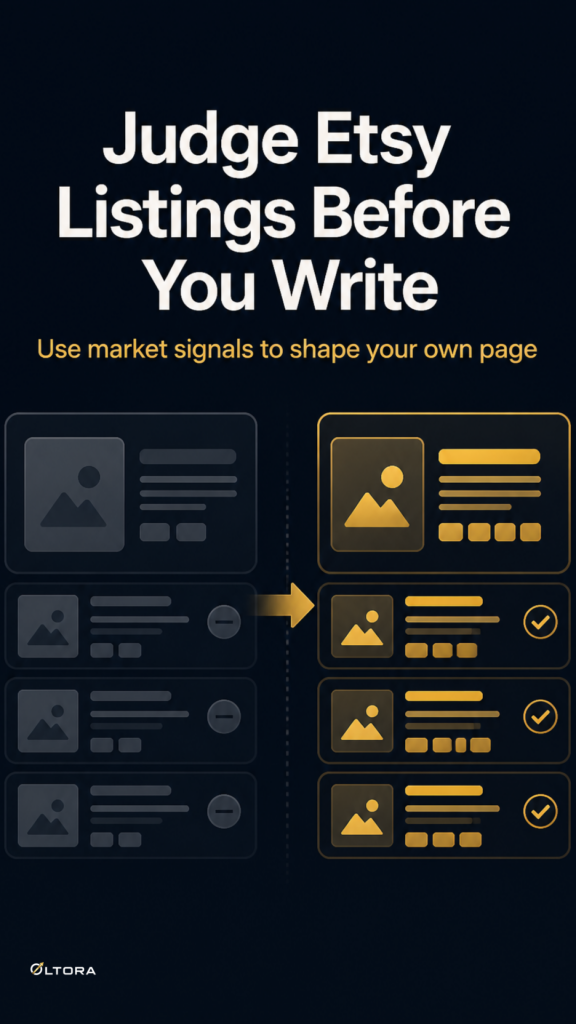
How to judge Etsy listings before you write your own
Sep
When the listing looks fine, but the decisions are still unclear
A lot of Etsy sellers reach the same frustrating point. The product is ready, the photos are passable, and the title draft has some promising words. Yet the listing still feels uncertain. Should the title be more specific? Is the price in the right range? Which details belong in the description, and which ones only make the page noisier?
That uncertainty usually shows up before the first listing goes live. It is especially common for sellers launching a new product, because there is no past performance to lean on. The temptation is to keep adjusting the copy until it sounds “right.” The better move is to step back and ask what the market is already signaling.
Etsy Competitor Research & Original Listing Blueprint is built for that earlier decision point. It takes visible market patterns from a competitor shop and turns them into original listing direction, including title ideas, 13 Etsy tags, description direction, pricing direction, and product-angle guidance for digital or physical products.
What to look for before you rewrite anything
Competitor research is useful only when it helps you make better choices. If you treat it like a pile of screenshots, it gets noisy fast. If you treat it like a way to answer a few specific questions, it becomes easier to use.
Before you start rewriting a draft, look for these practical signals:
- How the competitor names the product in the title
- Which words appear often enough to suggest buyer language
- Whether the listing explains the product quickly or slowly
- What kind of product angle seems common in the niche
- Where pricing appears to sit in relation to similar products
Those signals do not tell you what to copy. They tell you what the market keeps making obvious. That difference matters. A listing that follows a pattern blindly can feel borrowed. A listing that uses the pattern to sharpen its own position can feel much clearer.
Why a title draft is rarely the first problem
Many Etsy sellers start with the title because it feels like the most visible part of the page. But a weak title is often a symptom, not the root issue. If the product angle is fuzzy, the title becomes fuzzy. If the buyer’s first question is not obvious, the title tries to do too many jobs at once.
A stronger competitor review helps you sort out the order of decisions. You can decide what the product needs to prove before you decide how to phrase it. That is especially helpful when the niche has a lot of similar-looking listings. In those cases, the title should not carry the whole burden of differentiation. It should reflect a clearer choice about position.
For example, if competitor titles cluster around the same kind of product wording, that may suggest a shared buyer language. But it may also reveal an opening: one listing could be more specific about use case, format, or audience without becoming awkward. Research should help you see where that opening is, not push you into repeating the same sentence structure as everyone else.
How the blueprint helps digital and physical products differently
The service is not limited to one product type, but the output can be shaped differently depending on what you sell.
For digital products, the most useful guidance often centers on naming, tagging, and the way the listing explains the file or format. A printable, template, workbook, or planner may already be useful. The challenge is making the buyer understand why this version deserves attention.
For physical products, the blueprint can support more visual and practical decisions. The listing may need clearer hero image direction, close-up angle ideas, scale shots, reference shots, or lifestyle positioning. Those choices help the buyer understand size, function, and use more quickly.
That is one reason a generic rewrite rarely works well. A digital listing and a physical listing may share the same platform, but they do not ask the buyer to decide in the same way.
What original direction looks like in practice
Original direction does not mean starting from nothing. It means using research to make a cleaner set of decisions for your own page.
Here is what that can look like in practice:
- A title that reflects the product’s real angle instead of stacking broad terms
- Tags that follow buyer language without repeating the same phrase in every slot
- A description that explains the offer in a clear order instead of wandering through features
- Pricing that sits in a credible range for the product type
- Product-angle guidance that helps the listing feel more distinct
If you are launching a new product, that kind of structure can save time later. You are less likely to keep rewriting the listing from scratch because the core decisions were made before the copy took shape.
When competitor research is worth the effort
This kind of research is most useful when you already know you need a stronger listing but do not yet know which part is holding it back. Maybe the title feels too generic. Maybe the tags are scattered. Maybe the product is solid, but the page does not tell a buyer enough fast enough.
It is also useful when you are working in a niche where similar products all seem to blur together. In that situation, the real advantage is not finding a perfect formula. It is seeing the recurring market patterns clearly enough to build an original listing around them.
That is the practical value of Etsy Competitor Research & Original Listing Blueprint: it turns a competitor shop review into direction you can actually build with, rather than leaving you with notes that are easy to save and hard to use.
What to expect from the process
After purchase, you send the Etsy competitor shop link you want analyzed. The research is then turned into a blueprint based on visible market patterns. The deliverable is designed to be practical, so you can use it to shape your own listing without copying another shop’s wording.
That matters because the goal is not to mirror a competitor. It is to understand what the market is already telling you, then make cleaner choices about how your product should be presented.
If your next Etsy listing feels stuck between too broad and too close to someone else’s shop, start with the market signals before you polish the copy. The listing usually gets clearer once the decisions behind it do.