
Custom Development
Project scope session for custom builds that need a cleaner first step
Jul
Project scope session for custom builds that need a cleaner first step
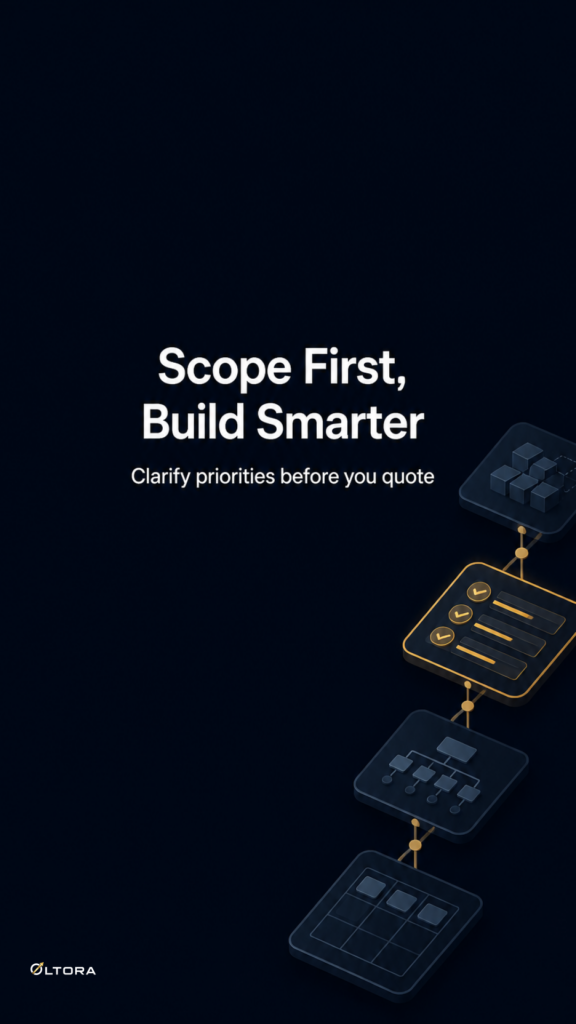
If a custom website, app, or platform idea is already circling in your head, the hardest part is often not the concept. It is deciding what belongs in the build now and what should stay out of the first version. A project scope session helps you do that before the work starts feeling vague or overgrown.
The point is not to turn every idea into a giant plan. It is to separate the problem you are actually trying to solve from the features that only seem necessary because they are easy to imagine. That is why a focused Custom Development Consultation can be useful even when you are still early in the process.
When people skip this step, they usually end up with one of two outcomes: a build that starts too loosely, or a quote that reflects assumptions instead of priorities. A short scope session gives you a clearer basis for both the conversation and the next decision.
Project scope session: the question to answer first
Before you think about design details or technical choices, ask a more basic question: what does this build need to do for the user or business? If you cannot answer that in plain English, the project is probably not ready for a full quote yet.
A useful scope session starts with the problem, not the wishlist. That means discussing the main use case, the kind of workflow the site or app should support, and the parts of the idea that are essential for version one. A flat-fee consultation makes more sense when you want a clear discussion, not a long and unfocused discovery call.
- Identify the main outcome the build should support.
- Separate core features from ideas that can wait.
- Note any constraints that affect the first version.
- Gather enough clarity to request a more realistic quote.
Signs your idea needs scope before build
Some projects feel ready because they are exciting, not because they are defined. That is where scope work earns its place. If the project keeps changing shape every time you describe it, the build is probably being asked to solve too many things at once.
You may need a scope session if you recognize any of these patterns:
- You can describe the general idea, but not the first user action.
- Different people involved in the project are imagining different outcomes.
- The feature list keeps growing while the core purpose stays unclear.
- You know you need custom development, but the order of priorities is unsettled.
These are not signs of failure. They are signs that the project deserves a better starting point. A short consultation can help you turn loose thinking into something a developer can actually respond to.
Project scope session vs. feature wish list
A wish list can be useful, but it is not the same thing as a usable brief. Wish lists collect possibilities. Scope sessions make decisions. That difference matters because the quote for a custom project depends on what is included, what is excluded, and what depends on another phase.
If you walk into a consultation with a long list of features, the goal should not be to defend every item. The better move is to rank them. Which features are essential for the first release? Which ones improve the experience but do not define it? Which ideas are better left for later?
This is also where a consultation can save time. Instead of asking someone to estimate a half-formed concept, you are giving them enough structure to understand the work and quote it more clearly. That tends to make the discussion more practical and less speculative.
Use the consultation to test assumptions
Many project owners assume they need a complex solution when a simpler one may do the job. Others assume a simple solution will hold up when the workflow actually needs more structure. A scope session is a good place to test those assumptions before they become expensive.
You do not need to arrive with polished technical language. A clear description of the problem, the audience, and the desired outcome is usually enough to make the conversation productive. From there, the discussion can help show which parts of the build are core and which parts are still open.
What to bring to a custom development consultation
The most useful input is concrete. If you can explain what the project should replace, support, or simplify, that gives the consultation more direction than a generic request for help. A few notes are often enough.
- A plain-language summary of the project goal.
- The main users or customer type involved.
- Any current process, site, or tool the build must improve.
- Questions about scope, priority, or quoting.
You do not need a perfect brief to begin. You just need enough context for the conversation to narrow the work properly. That is the real value of a project scope session: it helps turn a broad idea into a better starting point for development, without pretending the whole project has already been decided.
If your idea is ready to be discussed but not ready to be guessed at, a focused consultation is the right size of next step.