
SEO Strategy
How to choose keywords for a music link that serves one clear purpose
Sep
When a music link tries to say too much
A song page can look complete and still feel vague the moment someone outside the project opens it. The title may name the release, the description may mention the artist, and the keywords may try to cover every possible listener. The result is familiar: the page exists, but it does not say one clear thing well.
That usually becomes a problem when the link is shared before the page has a clean structure. One visitor may understand it as a single track. Another may read it as an artist profile. A third may land on it through search and not know what kind of music they are looking at. The issue is not volume. It is alignment.
A Music Visibility Report is useful at exactly that point because it looks at one public music link and turns the visible signals into practical guidance. But before you ask for a report, it helps to understand the architecture behind the page itself: which parts do different jobs, and which parts need to stay consistent.
Keep the page parts separate
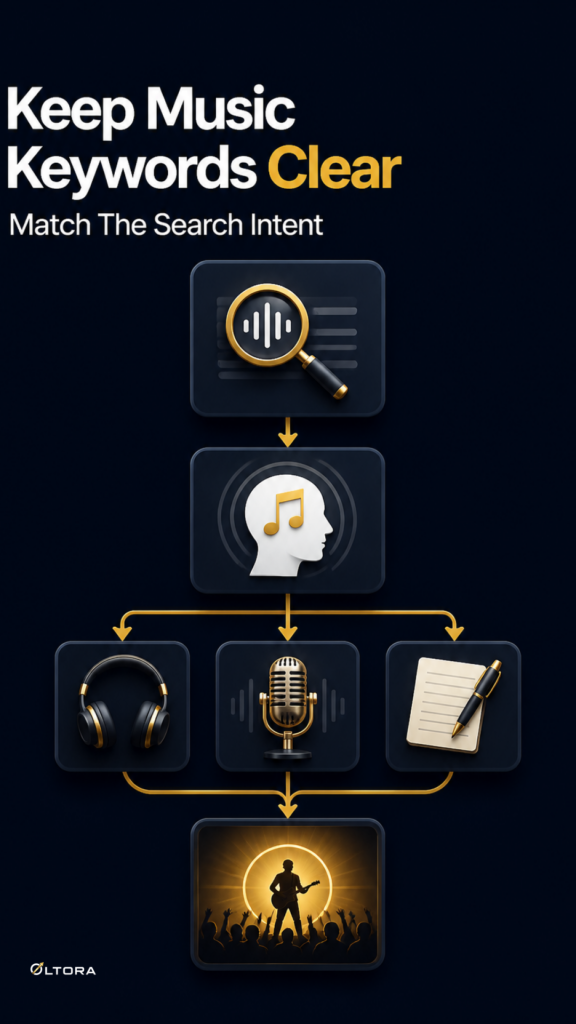
Think of the page as three layers that should work together without blending into one messy phrase.
- Identity: the artist name or project name
- Type: the format or genre context that tells a visitor what they are looking at
- Audience fit: the language that helps the right listener recognize the page as relevant
When those layers are confused, keyword selection gets noisy. An artist name gets overloaded with genre terms. A genre phrase tries to stand in for the title. Audience language gets added so broadly that it stops helping at all.
Preserving the difference between those parts matters because search visibility depends on clarity. A page that keeps identity, type, and audience in separate lanes is easier to read quickly and easier to edit later. A page that merges them into one long phrase often loses both precision and trust.
Start with the one thing the link should be found for
Before choosing keywords, decide what this public link is supposed to represent. A song page does not need the same keyword structure as an artist profile. A video link does not need the same wording as a release landing page. If you skip that decision, the keyword list grows faster than the page can support it.
A practical test helps here. Ask:
- Is this link meant to introduce one release?
- Is it meant to act as the main artist page?
- Is it a supporting page that should push visitors to a better primary link?
That choice shapes everything else. If the page is a release page, keywords should help the visitor identify the track and the style. If it is a profile, the language should support the artist identity first and the listener context second. If it is a supporting link, it should be specific enough to stand on its own without trying to do the work of the main page.
Use genre as a narrowing tool, not a catch-all label
Genre terms are useful when they reduce confusion. They are less useful when they become a substitute for explanation. A visitor should not need to guess whether a page is pop, ambient, rap, or acoustic based on scattered wording buried in the description.
Good genre language narrows the field. It tells the right audience, “this is likely for you.” Bad genre language tries to make the page searchable for everyone and ends up making it less specific for anyone.
That is why the keyword set should stay modest. One strong genre or style signal often does more work than several near-synonyms stacked together. If the page already has a clear title and a direct description, the keyword layer can stay light and still be useful.
Use audience words only when they add real context
Audience language can help when it reflects a real listening context. It becomes a problem when it sounds like a slogan. “For fans of…” or “perfect for…” can be useful if the page genuinely points toward a specific listener expectation. Otherwise, it becomes filler that weakens the main signal.
The safest approach is to keep audience terms concrete. Think in terms of who the page is likely for, or what the listener is likely looking for, rather than trying to appeal to every possible person. A page that says too little leaves people guessing. A page that says too much can sound generic.
This is where the page architecture matters again. Audience language should support the identity and type of the link, not replace them. If a listener cannot tell what the page is before they read the audience phrase, the keyword mix has gone out of balance.
Check for the failure mode: broad, but not readable
The most common mistake is not missing keywords. It is using keywords that technically cover a lot of ground while saying very little. That usually happens when the page tries to include:
- too many stylistic labels
- too many audience phrases
- too many versions of the same idea
On paper, that can look thorough. In practice, it creates a page that feels stretched thin. Search visibility does not improve just because the page uses more language. The page has to preserve meaning.
A cleaner rule is to keep only the phrases that help a stranger understand the page faster. If a keyword does not help identify the artist, narrow the genre, or clarify the listener context, it is probably not earning its place.
What a focused report should help you decide
Once the page has a clear structure, a report can help you see whether the public link matches the job it is meant to do. For one music link, that usually means checking:
- whether the title is clear enough
- whether the description supports the page purpose
- whether the keyword ideas fit the artist name, genre, and audience without blurring them together
- whether the link itself is the best one to promote as the main link
That kind of review is especially useful when you are preparing a page for longer-term search growth. You do not need a complicated workflow to find the weak point. You need one good read on the page as it is actually visible to the public.
That is the difference between general advice and a link-specific report. General advice tells you what often matters. A focused report tells you which signals are actually carrying weight on your page.
Why a PDF report can be the cleaner next step
Some music pages do need hands-on, ongoing support. Many do not. If the question is simply whether one public link is clear enough to support, a hosted PDF report can be the better fit than a broader consulting engagement. It is bounded, specific, and tied to the page you already have.
That matters because the risk is usually wasted effort. Without a clear read on the page, it is easy to keep rewriting the wrong layer: changing keywords when the title is the problem, or changing the description when the link choice itself is confusing. A report helps you avoid that loop by separating the moving parts first.
If the page needs to become easier to understand before you promote it further, keyword choice should serve that goal. Keep the artist name as the anchor, let genre narrow the field, and use audience language only when it makes the page more specific. That is how one music link stays readable instead of trying to represent everything at once.