
SEO & Link Building
How to read a backlink placement report before you approve the work
Sep
The problem starts before outreach begins
If you are considering link building, the hardest decision is often not whether you need more links. It is whether the work you are buying looks like real editorial placement or just a stack of unrelated mentions. That distinction matters because a backlink only helps when the source page, the surrounding context, and the destination all fit together. A report can make that easier to judge, but only if you know what to look for. For the product-specific workflow discussed here, see Authority Link Building & SEO Backlink Service.
That is where Authority Link Building & SEO Backlink Service is meant to be read as a placement-based service, not a mystery package. The workflow begins with a review of your website, niche, and target keywords, then moves toward relevant websites and contextual links. The final report is part of the product, so the report itself should tell you whether the work matches the brief.
Three parts do different jobs
Think of a backlink campaign as three separate pieces:
- The destination page, which is the URL you want to support.
- The source page, which is the real website where the mention appears.
- The report, which shows you what was placed, where it was placed, and how it was worded.
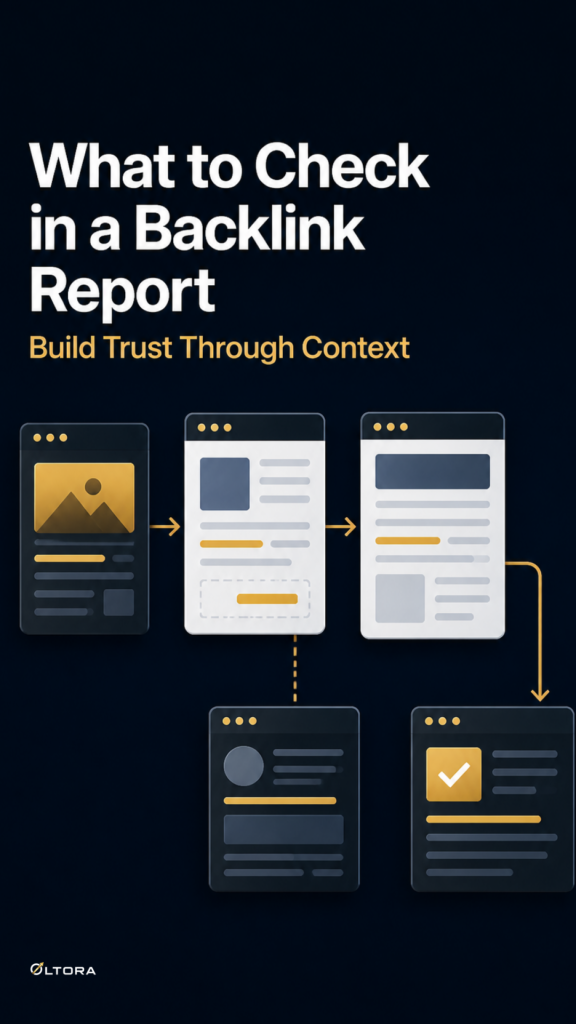
When those three pieces are blurred together, it becomes difficult to tell whether the campaign is doing useful work. A good report gives each part its own line of sight. You should be able to see the domain, the placement location, and the anchor text without having to guess how the link was used.
That separation matters for another reason: the strongest placement for a local business is not always the same as the strongest placement for an Etsy shop, a Shopify store, or a YouTube profile. The report should reflect the page you actually need to support, not just the broad idea of “getting a backlink.”
What makes a placement feel earned
Manual outreach is valuable because it lets the placement match the topic instead of forcing the topic to match the link. That does not mean every mention has to look identical. In fact, a natural backlink profile usually avoids repetition. Varying the anchor text and the link type helps the profile read like ordinary editorial behavior rather than a pattern built from a template.
When you review a placement report, ask a few practical questions:
- Does the source website have a real topical connection to the page you want to support?
- Does the link sit inside normal content rather than a thin block of unrelated references?
- Does the anchor text read naturally in the sentence?
- Is the destination page the one that actually needs support, or did the link drift to the wrong URL?
If the answer to the first three is yes, the placement is more likely to fit the purpose of the service. If the destination page is wrong, even a relevant source can waste effort. A homepage link, for example, may be too broad when a product page, service page, or category page is the real business target.
Why the destination page deserves as much attention as the source
Many backlink buyers focus on the referring domain and ignore the page receiving the link. That is a mistake. A link does more useful work when it points to the page that already has a clear role. For a local business, that may be a service page tied to a specific location or offer. For an online store, it may be a product page or collection page with a clear next step. For a creator, it may be the page that represents the song, video, or profile you want people to see.
This is where a placement report can either reassure you or expose a weak plan. If every link points to the homepage because it was easier to report, the campaign may be less focused than it should be. If the report shows a mix of destinations chosen for relevance, the work usually looks more deliberate.
What a useful report should let you verify
You do not need a long spreadsheet to understand a placement plan. You need enough detail to confirm that the work is built on real websites, contextual mentions, and sensible destination choices. A useful report should let you verify:
- the source domain for each placement
- the exact page or content area where the link appears
- the anchor text used for the mention
- whether the link points to the right page on your site or profile
That information helps you judge quality without treating link building like a blind buy. It also makes future decisions easier. If one type of source consistently fits your topic better than another, you can see that in the report instead of guessing after the fact.
Local businesses need a different kind of reading habit
If you are promoting a local business, the report needs to be read with a slightly different lens. A local presence often relies on more than one signal: the business profile itself, the relevance of the site or page being promoted, and the references pointing toward it from elsewhere on the web. A backlink report cannot replace those signals, but it can show whether the off-page work supports them.
That is especially useful when the business already has a complete profile but still feels easy to overlook. In that situation, the question is not how many links were collected. It is whether the links came from real, relevant websites that make sense beside the business topic. A report that only lists URLs without context is not much help. A report that shows topical fit and destination choice is far more useful.
What to approve, and what to question
A simple approval rule works well: approve placements that are relevant, contextual, and easy to explain in one sentence. Question placements that look rushed, overly generic, or disconnected from the page they are meant to support. If the link could sit on almost any website without changing the meaning, it is probably too weak to count as a meaningful editorial mention.
That does not mean every good placement has to be perfect or dramatic. It means the work should be understandable. You should be able to read the report and see why each link was pursued, where it lives, and what it supports. That is the difference between real outreach and a random list of URLs.
Used well, a backlink report becomes more than a receipt. It becomes a check on whether the campaign is building authority in a way that makes sense for your site, your profile, or your business. And if the report does not show that clearly, you have learned something valuable before the work grows larger.